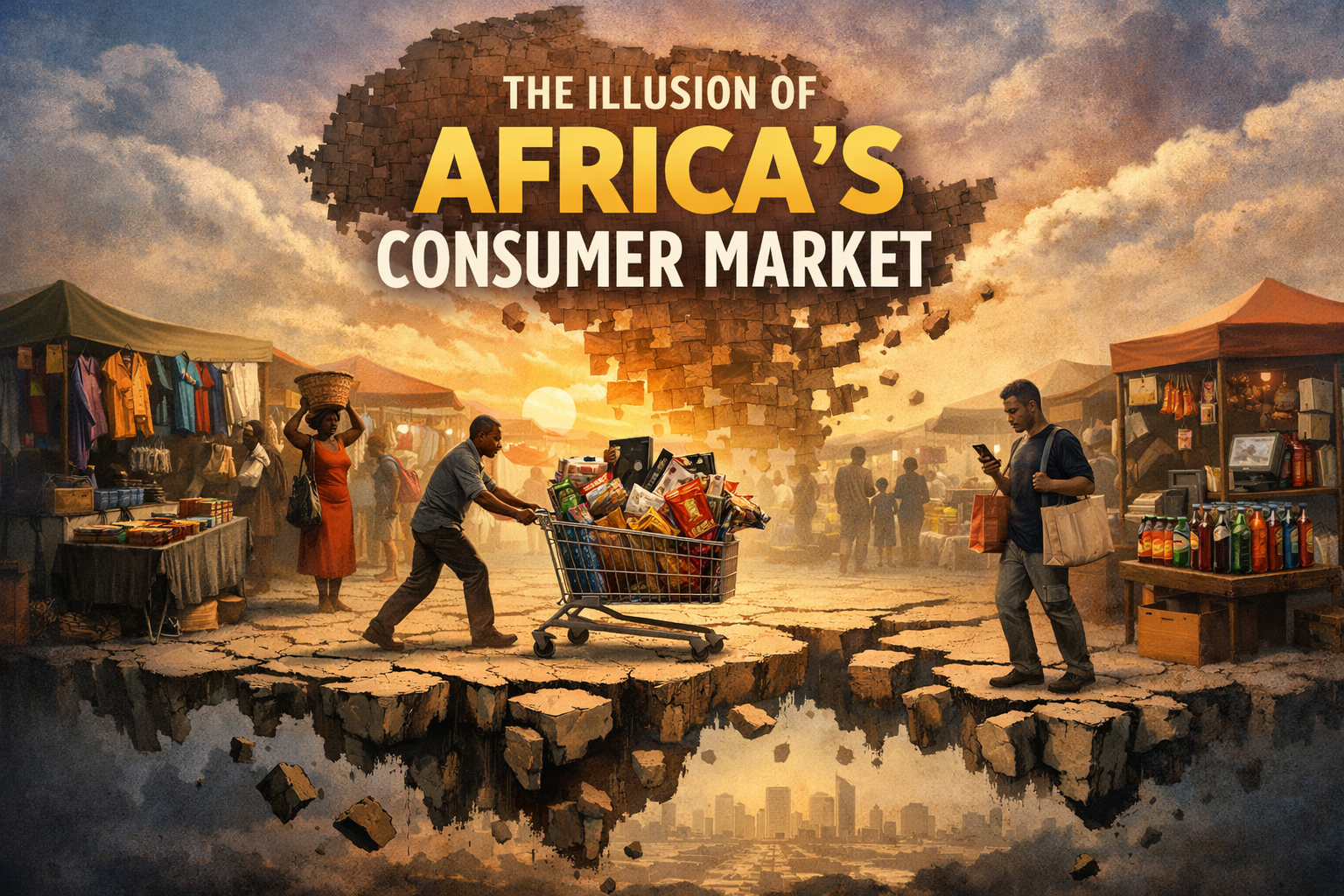
Africa's consumer market cannot be treated as one thing where every consumer thinks, behaves, and buys the same way. It is diverse, complex, and varies across regions, income levels, cultures, and behaviors.
Yet many brands still approach Africa's consumer market as a single, unified market. The thinking is often simple: if a campaign works in one city or country, it should work elsewhere with minimal adjustments. On paper, that assumption feels efficient. In practice, it is one of the fastest ways to stall growth.
From a performance marketing perspective, this mistake shows up very quickly in the data. A campaign launches in a major urban center like Lagos and performs well. Engagement is strong, conversions are consistent, and the cost of acquisition is within target. The natural next step is expansion. Budget increases, delivery widens, and the same creative and messaging are pushed into new regions.
Then performance drops.
Not always immediately, but consistently enough to raise questions. Cost per result begins to climb. The same ad that resonated strongly before now feels less effective. At this point, most reactions focus on surface-level fixes: refreshing creatives, tweaking targeting inputs, or adjusting budgets. But the underlying issue is rarely execution. It is misalignment.
What worked initially was not universally effective. It was contextually effective.
Consumer behaviour across African markets is shaped by a mix of economic reality, trust dynamics, cultural nuance, and access. Even within Nigeria alone, the differences are significant. A salary earner in Lagos with stable income and high exposure to digital products evaluates offers differently from a trader in Ibadan managing daily cash flow, or a first-time online buyer in a semi-urban area navigating trust concerns.
These differences are not minor. They directly influence how people interpret value, assess risk, and decide to act.
In practical terms, this means that the same product can require entirely different narratives to drive adoption across segments. In one context, urgency and price may be the dominant triggers. In another, reassurance and social proof carry more weight. Elsewhere, aspiration and perceived status may drive interest. When a single message is applied across all these realities, it tends to underperform everywhere except the segment it was originally aligned with.
Example One: Betting
A campaign built around "Instant withdrawals" performs strongly in Lagos, where users are already familiar with betting platforms and are comparing speed, odds, and experience. The message works because it taps into an existing behavior: users already trust the system. They just want a better version of it.
Take that same campaign and push it into a different segment, say newer users or regions where trust is still fragile. Performance drops. Not because the product is bad, but because the message skipped a step.
In that context, the real concern is not speed. It is:
- Is this platform legitimate?
- Will I actually get my money?
- Is this safe to try?
The campaign needed to shift from speed to trust: proof of payouts, testimonials, social validation. Same product. Different reality. Different trigger.
Example Two: Fintech
A "zero transfer fees" campaign drives strong acquisition among price-sensitive users, especially those already moving money frequently. The value is immediate and easy to understand.
But that same message often underperforms with slightly higher-income users or professionals who are less concerned about small fees and more concerned about:
- Reliability
- Transaction success rate
- Brand credibility
In that case, a message around "Transfers you can rely on. Every time." will often outperform a cheaper but less reassuring proposition. The difference is not the product. It is the priority of the user.
What This Means for Brands
The brands that win in African markets are not the ones with the biggest budgets or the most aggressive expansion plans. They are the ones that understand one simple thing: the same product does not mean the same message.
And until that becomes clear in how campaigns are built, tested, and scaled, growth will continue to look inconsistent. Not because the opportunity is not there, but because the strategy is too narrow for the reality it is trying to capture.
The same product does not mean the same message.